 EU TRADE LTD
Corporate Branded Merchandise Buying Guide for the UK and Europe
Choose useful products, plan your budget and prepare for UK and European audiences
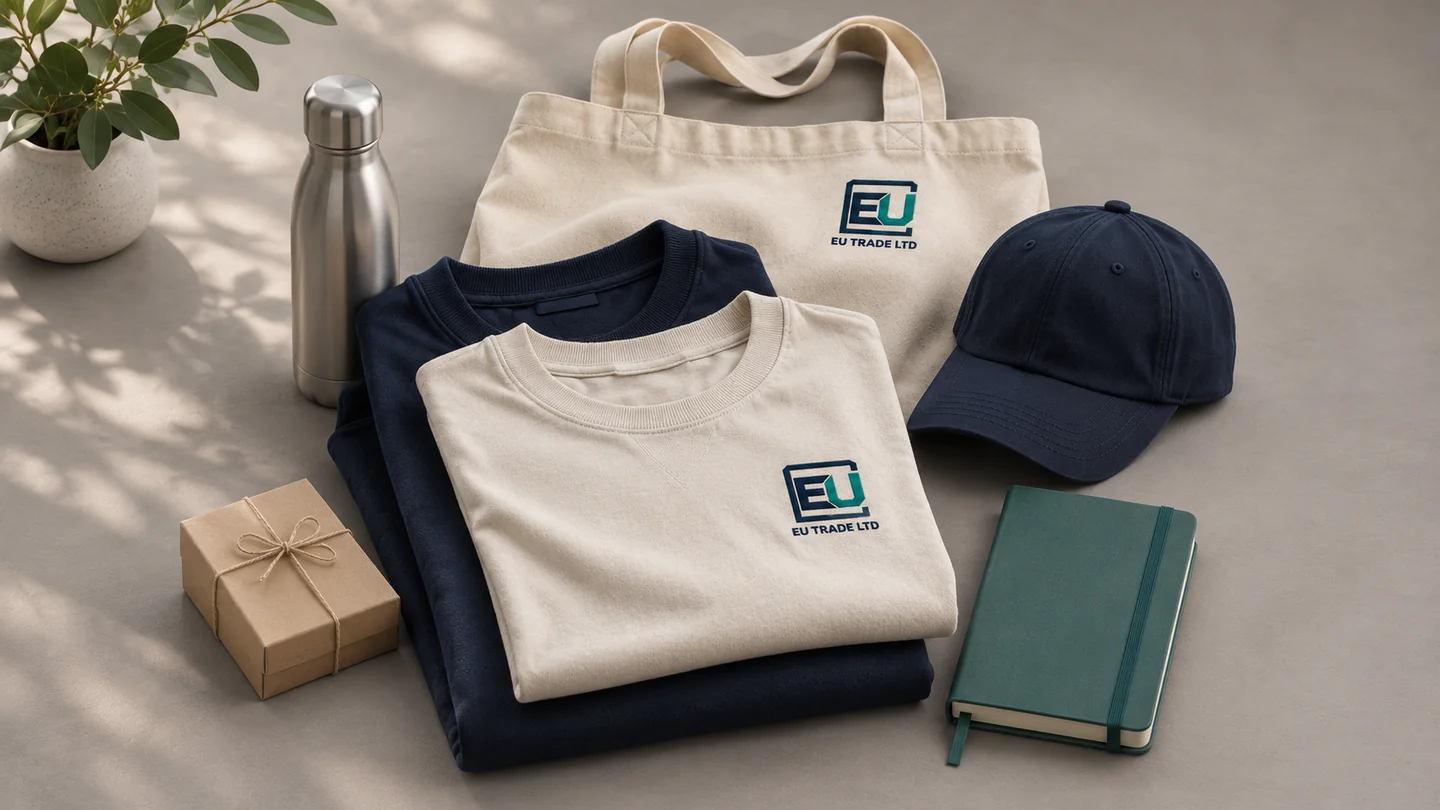
Corporate branded merchandise works best when the product suits the people receiving it. A comfortable staff T-shirt, a useful conference tote or a carefully chosen welcome pack can keep your organisation visible through everyday use. Choosing well means balancing the audience, quality, artwork, total cost and delivery deadline.
This buying guide helps marketing, HR and procurement teams in the UK and Europe plan an order, compare suppliers and prepare for distribution. It covers common merchandise categories, customisation methods, budgeting and the differences to consider when ordering across borders.
Ordering from EU TRADE LTD: Our current range covers blank or custom printed T-shirts, hoodies, sweatshirts, caps and tote bags, with UK delivery. Other products discussed below are general buying examples. European delivery is planned for a later phase; please confirm availability before planning an order for a destination outside the UK.
In this guide
1. What is corporate branded merchandise?
Corporate branded merchandise is a physical product customised with an organisation’s logo, colours or artwork. It includes clothing, bags, stationery, drinkware and other items used for staff, clients, events and promotional campaigns.
The purpose is to give recipients something useful that also represents your business. A logo alone does not make an item effective: the product should be appropriate for its audience, comfortable or convenient to use, and good enough to carry your name.
2. Why businesses use branded merchandise
Merchandise can support several business objectives. Decide which matters most before comparing products, so you can judge the order against a clear purpose.
- Brand recognition: useful products create opportunities for repeated exposure when recipients use them.
- Employee onboarding: coordinated clothing or welcome items can introduce new starters to your organisation.
- Client relationships: a relevant gift can acknowledge an established working relationship.
- Events and campaigns: teamwear and practical giveaways can support a consistent exhibition or launch presence.
These are potential benefits rather than guaranteed results. Where practical, ask recipients what they use and review leftover stock, feedback and repeat requests before placing your next order.
3. Choose a suitable product category
Clothing and apparel
T-shirts, hoodies, sweatshirts and caps are practical starting points for staff, promotions and events. Consider fabric composition, weight, fit, stitching and care requirements alongside the branding area.
Collect sizes before ordering and compare the supplier’s actual measurements. Size labels can vary between brands and markets; a familiar UK or European size label does not guarantee the same fit. For a large team, a sample or size check can reduce avoidable mistakes.
Bags and travel accessories
Tote bags can hold event materials and offer a visible print area. Check fabric strength, seam quality, handle length, capacity and the weight the bag is intended to carry. Backpacks and laptop bags are other market options, but availability must be checked with the supplier.
Drinkware
Mugs, reusable bottles and travel cups are common corporate gifts. Assess lid fit, cleaning instructions, capacity and suitability for the intended drinks. Request relevant food-contact documentation rather than relying on appearance or a generic product description.
Stationery and office accessories
Notebooks, pens, planners and desk accessories can suit conferences and office welcome packs. Compare paper quality, binding, refill availability and the finish of the customised product. Choose a useful format rather than adding items simply to make a pack look larger.
Technology accessories
Laptop sleeves, cable organisers and phone stands may suit office-based recipients. Electronic products such as chargers need closer checks on compatibility, technical specifications, safety documentation and warranty arrangements. Keep passive accessories and powered devices separate when comparing requirements.
Gift sets and welcome packs
A coordinated pack can combine clothing, a bag and selected office items. Check the quality of each component and include assembly, packaging and distribution in the quotation. A smaller set of relevant products is often easier to manage than a box filled with items recipients will not use.
4. Match the products to your audience
Write a short brief describing who will receive the merchandise, what it should achieve and where it will be used. The same item may work well for one audience and poorly for another.
| Audience | Possible products | Main buying consideration |
|---|---|---|
| Employees | Teamwear, tote bags, welcome items | Comfort, inclusive sizing and regular use |
| Clients and partners | Selected gift sets or personalised office items | Relevance, presentation and the recipient’s gift policy |
| Exhibition visitors | Tote bags, stationery or suitable giveaways | Ease of carrying, usefulness and distribution |
| Campaign teams | Printed T-shirts, caps or sweatshirts | Consistent artwork, fit and the event deadline |
For a UK conference, consider how visitors will travel home with the item. For a programme across several European offices, ask local teams about language, climate, sizing and working arrangements. Check client gift policies before committing to higher-value items.
5. Plan the complete merchandise budget
Compare the total cost of an equivalent finished order, including products, customisation, artwork preparation, packaging and delivery. Ask suppliers to state whether taxes are included and to identify charges for samples, separate destinations or urgent work.
UK quotations commonly use pounds sterling (GBP); suppliers in the euro area may quote in euros (EUR), while other European countries use different currencies. Record the quotation currency, validity period and exchange-rate assumptions when comparing overseas suppliers.
| Cost component | Example amount in GBP |
|---|---|
| 500 notebooks at £4 each | £2,000 |
| Artwork and setup | £80 |
| Custom packaging | £150 |
| Delivery | £120 |
| Subtotal before applicable VAT | £2,350 |
This is a hypothetical budgeting example, not an EU TRADE LTD product offer or quotation. Actual costs and VAT treatment depend on the goods, supplier and transaction. The example illustrates why a unit price alone is insufficient.
Confirm minimum quantities, repeat-order arrangements and the number of recipients. Avoid surplus stock that could become outdated after a rebrand. EU TRADE LTD discusses quantities and specifications during the enquiry process; there is no fixed minimum order quantity across our current offering.
6. Assess sustainability and packaging claims
Start with usefulness, durability and realistic quantities. A reusable product does not automatically have a lower environmental impact: materials, manufacturing, transport, lifespan and disposal all matter.
Ask for evidence behind terms such as recycled, organic or responsibly sourced. Establish which component a claim covers, the material percentage where relevant, and whether supporting certification applies to the actual product. Avoid repeating broad claims that the supplier cannot substantiate.
The CMA Green Claims Code and its supply-chain guidance explain how UK businesses should approach environmental claims. Use them when preparing product descriptions and campaign copy.
Keep packaging proportionate to protection and presentation needs. Businesses supplying or importing packaging or packaged goods should check whether UK extended producer responsibility requirements apply to their activities. Check destination-specific packaging obligations for European distribution rather than assuming UK arrangements cover every market.
7. Select the right printing or customisation method
The appropriate method depends on the material, artwork, quantity and expected use. The following are general industry options; ask each supplier which methods they actually offer for the chosen product.
- Screen printing: often considered for suitable garments and bags, particularly repeat designs with a limited colour palette. Setup and quantity affect the economics.
- Embroidery: a stitched finish for compatible fabrics. Small lettering and fine details may need simplifying.
- Digital garment printing and transfers: potential options for detailed or multicoloured designs. Fabric compatibility, finish and care instructions depend on the process.
- Laser engraving: used on suitable metal, wood and other compatible surfaces; the resulting colour depends on the material and finish.
- Pad printing: an option for certain small or curved promotional products.
Supply clean artwork and your colour references. Approve the logo dimensions, position and orientation in writing, and ask how colour matching is handled on the chosen material. A digital proof helps check layout; request a physical sample where the actual finish is critical.
For our current clothing and bag range, send your artwork requirements with a quote request so we can discuss the available printing options.
8. Plan merchandise for the occasion
Employee onboarding and internal events
Choose products that fit the role and working environment. Collect clothing sizes privately, check quantities against confirmed starters or attendees, and decide whether items go to a workplace or individual addresses.
Conferences and trade shows
Confirm venue access, delivery booking requirements, storage and the person responsible for receipt. Plan around the date products must be at the venue, including time to inspect and distribute them. A deadline in London, Frankfurt or Amsterdam needs the same careful scheduling even when the shipping arrangements differ.
Client gifting and launches
Check the recipient’s gift policy, presentation requirements and campaign artwork before production. Avoid printing an event date unless it serves a clear purpose: undated items may remain useful if plans change or stock is carried forward.
9. Compare suppliers and agree the order details
Give shortlisted suppliers the same brief so their quotations are comparable. Ask for product specifications, samples where practical, the customisation method, an itemised price, payment terms and a realistic production and delivery schedule.
Confirm who handles artwork approvals, quality concerns and delivery enquiries. Record what happens if a sample is unsuitable, artwork changes after approval, or a deadline moves. Agree cancellation and order-change terms before paying rather than assuming customised goods can be altered at any stage.
For an event order, establish whether the quoted delivery date is a commitment or an estimate and how delays will be communicated. Keep the approved proof, final quantities, destination details and order confirmation together for future reference.
10. Account for UK and European market differences
Europe is not a single customs, currency or regulatory market. Establish the destination country and the route the goods will take before comparing cross-border offers. Great Britain, Northern Ireland, EU member states and other European countries can require different checks.
Delivery, currency and import costs
Confirm who arranges shipping and customs clearance, who acts as importer, and who pays any applicable duties, import VAT and handling charges. Ask which costs are included in the quoted delivery terms. Where relevant, use the UK government’s EORI guidance to check the identification requirements for moving goods.
Allow time for artwork approval, production, inspection, dispatch and final distribution as separate stages. For EU TRADE LTD’s current UK service, the stated minimum delivery timeframe is 7–10 working days after dispatch; production and preparation time are separate and discussed before ordering. Read our delivery and returns information and confirm suitability for your deadline.
Product safety and textile information
Identify the requirements for the actual product and destination. The EU General Product Safety Regulation has applied since 13 December 2024 to products within its scope. The European Commission’s guidance on business obligations is a starting point for checking responsibilities; product-specific requirements may also apply.
For textiles sold to consumers in the EU, check fibre-composition information and the language requirements of the countries where they are offered. Consult the official EU textile labelling guidance. Do not assume a supplier’s domestic labels or documentation cover every intended destination.
Language and local use
Review printed inserts, instructions, slogans and packaging with the relevant local team. Check translations before approving artwork and make sure essential product information remains legible after branding. Confirm local holidays and office opening dates when planning distribution.
11. Avoid common buying mistakes
- Buying on price alone: compare the finished product, specifications and complete delivered cost.
- Skipping approval: check artwork placement, spelling, dimensions and colours before production.
- Assuming sizes match: use measurements and samples instead of relying only on size labels.
- Planning only for shipping: include preparation, production, inspection and distribution time.
- Ordering too much: base quantities on likely use and keep dated or campaign-specific surplus low.
- Overlooking market differences: check language, labelling, import costs and destination requirements.
- Repeating unsupported claims: obtain evidence for environmental and product-performance statements.
12. Use this checklist before confirming an order
- Brief: purpose, recipients, quantity, size breakdown, budget and required arrival date are agreed.
- Products: specifications, materials, colours and samples have been reviewed where needed.
- Artwork: final files, branding method, placement, dimensions and proofs are approved.
- Price: setup, customisation, packaging, taxes and delivery charges are identified.
- Terms: payment, changes, cancellation and quality-query arrangements are understood.
- Destinations: addresses, venue instructions, customs responsibilities and recipients are confirmed.
- Product information: relevant safety documentation, labels, languages and environmental evidence have been checked.
- Schedule: production and delivery stages leave time for inspection and distribution.
13. Frequently asked questions
Which merchandise works well for corporate events?
Printed T-shirts, caps and tote bags can suit teamwear and promotions. Stationery and drinkware are other general options. Choose according to the audience, carrying convenience, budget and likely use.
How much does branded merchandise cost?
There is no single price. Product specifications, quantity, artwork, customisation, packaging and delivery all affect the total. Compare itemised quotations in the same currency and check whether VAT and any import charges are included.
Can I place a small order?
Minimum quantities vary by supplier, product and branding method. EU TRADE LTD has no fixed minimum quantity across its current offering; send the product and quantity you need so suitability and pricing can be discussed.
How early should I order?
Ask for a schedule based on your actual specification and destination. Include artwork approval and production as well as shipping. Do not treat a delivery estimate after dispatch as the complete order lead time.
Can the same products be used across the UK and Europe?
Potentially, provided the products and their information meet the requirements of each intended destination. Check language, sizing, safety, labelling and distribution arrangements before committing to a multi-country programme.
Does EU TRADE LTD currently deliver across Europe?
Our current delivery service covers the UK. European delivery is planned for a later phase. This guide is written for UK and European readers, but it does not confirm delivery availability outside the UK.
Does EU TRADE LTD supply every product mentioned here?
Our confirmed range is T-shirts, hoodies, sweatshirts, caps and tote bags, supplied blank or with printing. Drinkware, stationery, electronics and other categories in this guide are general market examples.
Plan your next branded merchandise order
Start with a clear audience and purpose, select a useful product and compare the complete cost. Approve the artwork, agree the schedule and check the requirements for every intended destination before confirming production.
For branded clothing and tote bags with UK delivery, tell EU TRADE LTD your preferred products, quantities, artwork needs, delivery postcode and required date. We will discuss printing options, pricing and delivery arrangements before you order.
For ongoing print-on-demand supply or fulfilment, use our seller enquiry form.